
Women Hair Transplant in India: What You Actually Need to Know Before You Decide
- Dr haror's Wellness

- Jul 13
- 4 min read
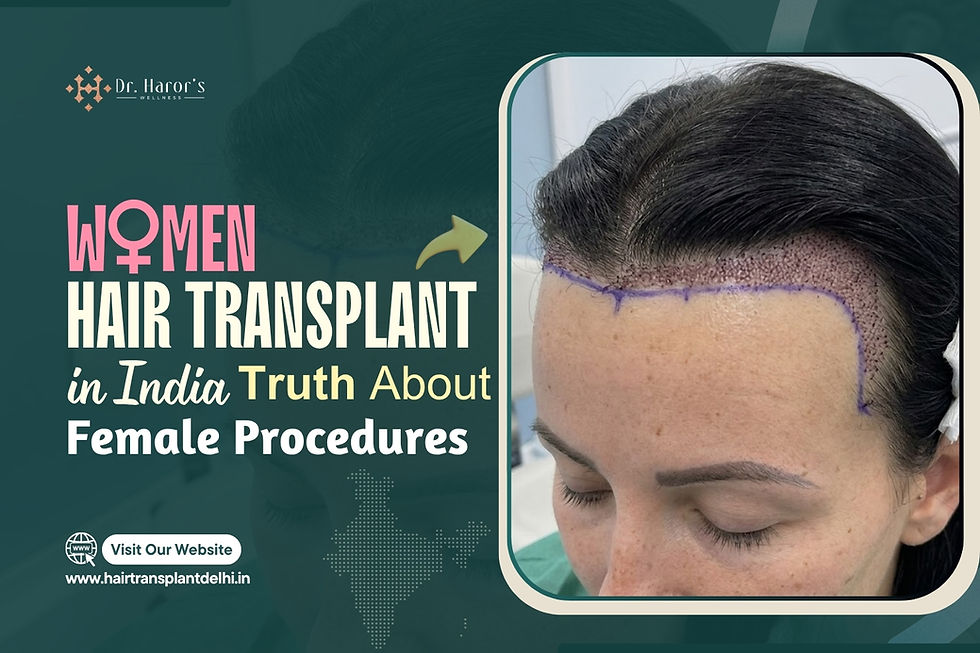
Losing hair hits differently when you're a woman. Nobody warns you about it the way they do with men — there's no "it runs in the family, don't worry" script waiting for you. So when the thinning starts, or that part in your hair looks wider than it did last year, it's normal to feel caught off guard. The good news is that a Women Hair Transplant in India has become one of the most reliable, affordable, and genuinely effective ways to get that hair density back — if you go in informed.
This guide breaks down what the procedure actually involves, which technique might suit you, and how to tell if you're even a good candidate in the first place.
Why Hair Loss in Women Is Different From Hair Loss in Men
Men typically lose hair in a predictable pattern — receding hairline, crown thinning, and so on. Women, on the other hand, usually experience diffuse thinning across the scalp, which makes both diagnosis and treatment trickier. That's exactly why a Women's Hair Transplant in India is planned as a completely different surgical approach than a standard male transplant, right down to how the surgeon designs the hairline and distributes the grafts.
The Main Techniques Used in a Women Hair Transplant in India
Clinics across India generally offer three techniques, and each comes with its own trade-offs.
1. FUT (Follicular Unit Transplantation)
Often called the "strip method." The surgeon removes a thin strip of scalp — usually from the back of the head — that contains healthy grafts, each carrying 2–3 hair strands. It's an older, well-established technique, but it does leave a linear scar that can show up if the hair is cut very short or gets wet. For women who plan to keep some length, this is rarely a visible issue.
2. FUE (Follicular Unit Excision)
Instead of removing a strip, individual follicles are extracted one at a time using tiny punch tools. It's less invasive, heals faster, and leaves no linear scar — just small, scattered dots that are easy to hide even with short hair .
3. DHI (Direct Hair Implantation)
This is usually the go-to option for women, mainly because it doesn't require shaving the entire scalp — a big deal for anyone not ready to deal with a full buzz cut. A specialized implanter pen extracts and places each follicle directly into the thinning area in one motion, allowing very precise control over angle, direction, and density. Graft survival rates with DHI also tend to be higher than with older methods.
Myths About Women's Hair Transplants — Sorted From the Facts
What People Assume | What's Actually True |
Hair transplants are a "men's thing." | Women are just as suitable for the procedure, provided they meet the candidacy criteria. |
The results always look fake or unnatural. | With modern hairline design and graft placement, results blend in with natural growth patterns. |
Every woman losing hair needs surgery. | Many cases respond to medication or non-surgical regenerative treatments instead. |
Recovery takes months of downtime. | Most women are back to normal routines within a few days; it's the new hair growth that takes longer to show. |
Transplanted hair eventually falls out again. | Some shedding right after the procedure is completely normal — it's followed by new, permanent growth within a few months. |
Am I a Good Candidate for a Hair Transplant?
Not everyone with thinning hair needs or qualifies for a transplant. Generally, you're considered a strong candidate if:
You have enough healthy donor hair available (typically at the back or sides of the scalp)
Your hair loss pattern has stabilized rather than being actively progressive
You've already tried medical treatments or over-the-counter options without meaningful results
If you're unsure where you fall, that's exactly what a proper consultation is for a qualified surgeon can evaluate your scalp, donor density, and hair loss pattern before recommending anything.
Quick Answers: Women's Hair Transplant
FAQs
Is a hair transplant painful for women?
The procedure is done under local anesthesia, so discomfort during the surgery itself is minimal. Mild soreness for a few days afterward is common and manageable with medication.
Do I need to shave my head for a women's hair transplant?
Not necessarily. Techniques like DHI allow grafts to be implanted between existing hair without shaving the whole scalp.
How long before I see actual hair growth?
Initial shedding of transplanted hair is normal in the first few weeks. New, permanent growth typically begins around the 3–4 month mark, with fuller results visible by 8–12 months.
Is the result permanent?
Yes — grafts are usually taken from areas genetically resistant to hair loss, so the transplanted hair continues to grow naturally for life.
How is a women's transplant different from a men's transplant?
The hairline design, graft angling, and density planning are approached differently, since women's hair loss patterns and aesthetic goals typically differ from men's.
Final Thoughts
Hair loss can quietly chip away at your confidence, but it doesn't have to be permanent or something you just live with. A Women Hair Transplant in India offers a safe, well-established path back to natural-looking density for the right candidates — the key is getting an honest, thorough evaluation before choosing a technique or a clinic.
If you're considering your options, book a consultation with Dr. Haror's Wellness. Their team specializes in hair restoration for both men and women across all age groups, using modern tools and techniques built around natural, lasting results.


Comments